


Simple Habits That Build a Strong Body & Mind
Sometimes the best life advice fits in just a few lines
The more you walk the better you feel.
The more you lift the more muscle you build.
The more you get outside the happier you are.
The more hard things you do the easier your life becomes.
Walk. Lift. Get outside. Do hard things.
This is the way.
Source: @mindset.therapy
Happy Nordic walkers in High Park, Toronto

The Best Places to Nordic Walk in Toronto: High Park & Mount Pleasant Cemetery
Looking for the perfect locations to enjoy Nordic walking in Toronto?
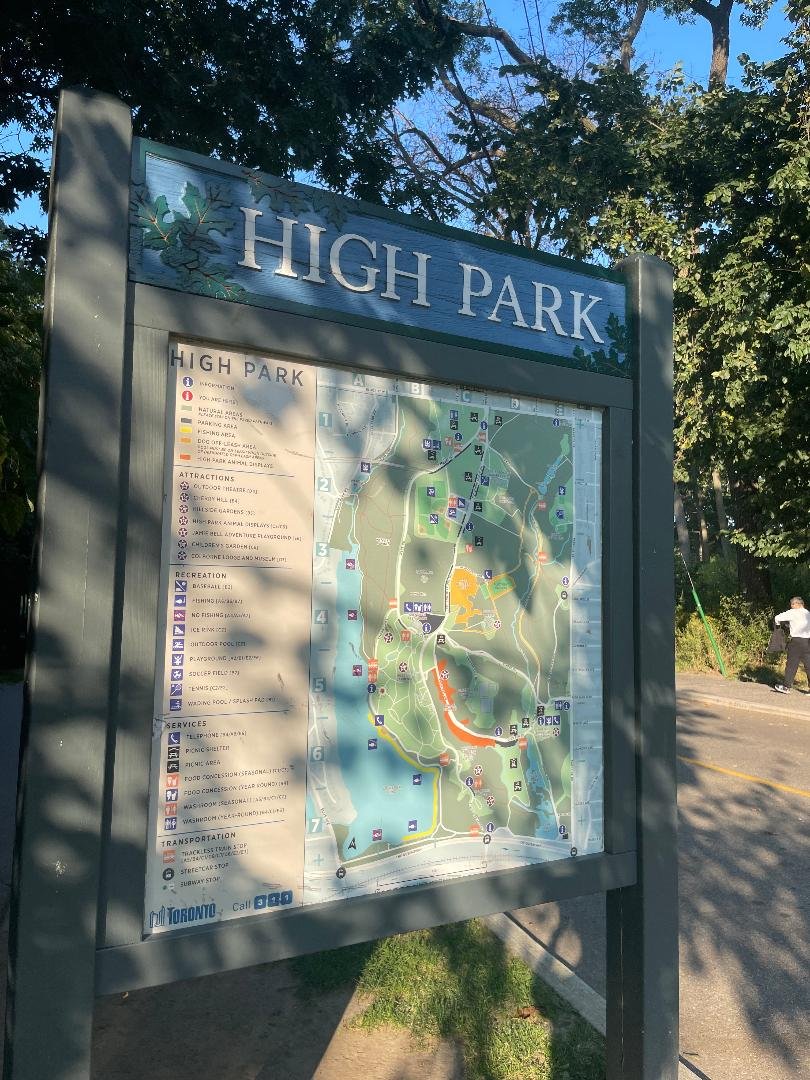
Looking for the perfect locations to enjoy Nordic walking in Toronto?
Let me introduce you to two of the city’s best spots: High Park and Mount Pleasant Cemetery.
1. High Park – A Nordic Walker’s Dream
High Park, located in Toronto’s west end, is famous for its variety of trails making it a fantastic destination for Nordic walking enthusiasts.
If you’re looking for a challenge, this park has some steep hills and staircases that will get your heart pumping. The wooded paths allow you to experience nature at its finest – towering forest, lush greenery, beautiful flowerbeds, and the sounds of singing birds.
One of the best parts of Nordic walking here is the peaceful atmosphere. Despite being a popular park, there is room for everyone and very little car traffic. On weekends the park is closed to cars making it a walker’s dream location.
2. Mount Pleasant Cemetery – Serene and Scenic
If you’re after a walking experience that is even more serene, Mount Pleasant Cemetery, in midtown Toronto, is the ideal choice.

The sprawling 200-acre cemetery offers smooth, flat roads, making it a perfect option for Nordic walkers of all skill levels, especially beginners who aren’t ready to tackle hills and stairs.
The beauty of Mount Pleasant lies in its peaceful environment – it is quiet, almost car-free, and dotted with beautiful headstones, sculptures, flower gardens, and fountains. The rich history and thoughtful design of the cemetery makes walking workouts both relaxing and energizing.
******
While you can explore both High Park and Mount Pleasant Cemetery without poles, taking your Nordic walking poles adds multiple benefits.
With poles you will:
activate more muscles
burn more calories
enjoy a full-body workout.
Plus, research shows that people with Nordic walking training and who walk with a group are more likely to stick to their fitness goals and to exercise more frequently.
If Nordic walking sounds intriguing, check here for information on my 75-minute one-time Quick-Start Clinics and seasonal 12-week sessions. Where? You guessed it, High Park and Mount Pleasant Cemetery!

The Benefits of Engaging Your Brain During a Workout
Boost your brain health with exercise.

"Exercise seems to boost brain health in different ways, both immediately and over the long term......
It triggers the production of brain-derived neurotrophic factor, or BDNF, which spurs the growth of new neurons in the hippocampus, a region of the brain associated with learning and memory.
That's important because the hippocampus is shrinking by about half a percent a year by the age of 55, and that shrinkage is associated with declines in learning, memory and spatial thinking.
Scientists now believe that lactate "functions as both a chemical signal and as a fuel for cells throughout the body, including brain cells" rather than a "poison which made your muscles burn during exercise".
"The lactate you produce during hard exercise fuels your brain cells and also sends a signal to activate BDNF.
The BDNF, in turn, facilitates "long-term potentiation" which essentially means that the connections between any nerves that happen to be firing will be strengthened.That implies that what you do with your brain during exercise matters because those are the neural pathways that will be reinforced"
Alex Hutchinson, The Globe and Mail, July 29, 2024
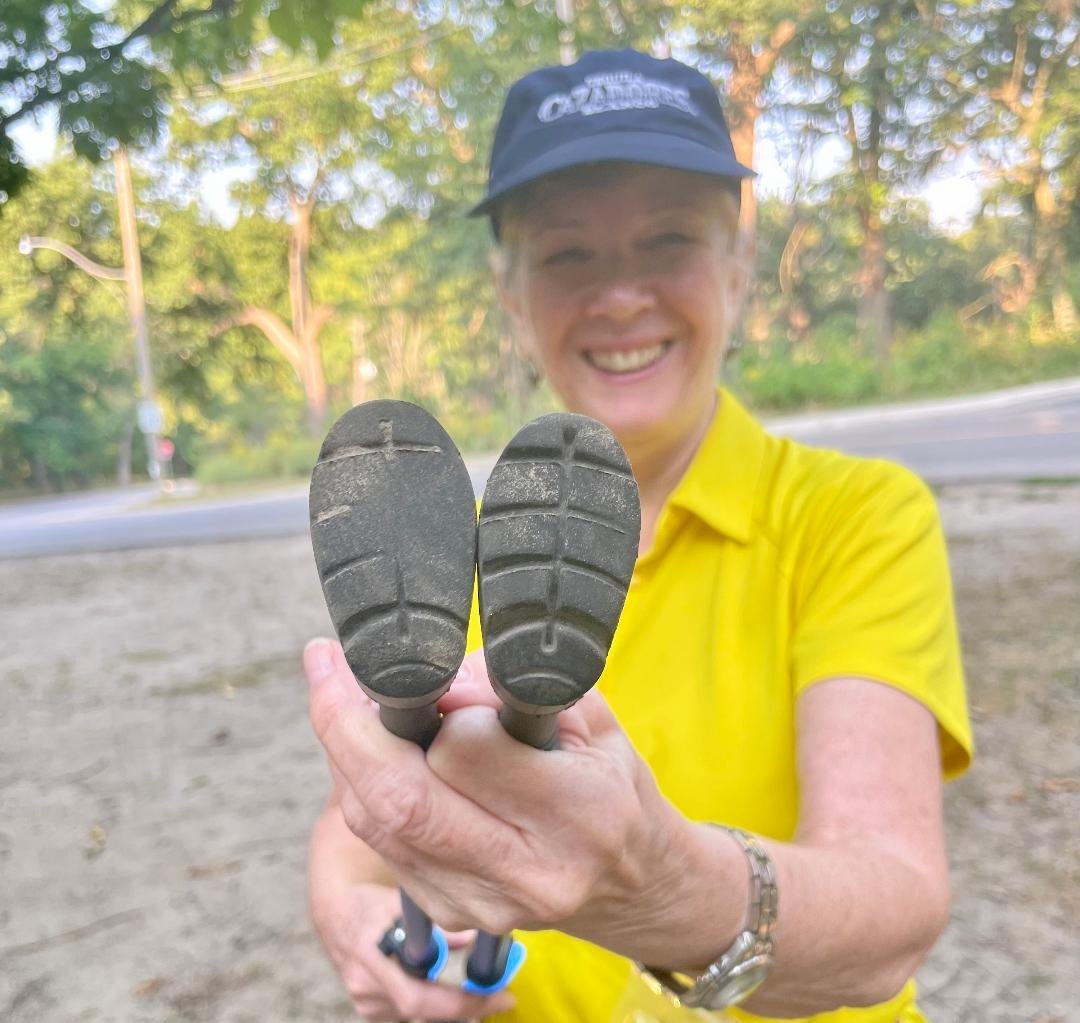
Have You Checked Your Nordic Walking Pole Boot Tips Lately?
Improve your Nordic walking technique to extend the life of your boot tips.
If you haven’t checked the boot tips of your Nordic walking poles recently, now is a great time—especially if you’re new to the activity.
Uneven wear on the boot tips, one smooth and one still with tread, often signals a technique issue related to your dominant and non-dominant arms.
The dominant arm typically masters the Nordic walking motion more quickly, lifting the boot tip slightly off the ground with each swing—an essential part of proper form. However, the weaker, non-dominant arm may drag the boot tip forward instead, which leads to faster wear and tear.
The fix is simple:
• Lift with your fingers: Use a subtle lifting action with your pinky and ring fingers to raise the boot tip just slightly off the ground. as your pole swings forward.
• Check your swing height: Ensure the pole handle of your non-dominant arm swings up to the very same height as that of your dominant—right to a “handshake position.”
If the handle swing is too low, the boot tip will slip back along the ground instead of planting. To correct this, swing the handle on your non-dominant side an inch or two higher (to a full handshake height) .
Avoid bending your elbow or altering your overall technique. Focus on the small adjustments of lifting slightly with the fingers and swinging both handles to a handshake height..
Pro Tip
Pay attention to the sounds your boot tips make. A consistent, quiet “thud” from both indicates proper form. If one boot tip drags or slips, the difference in sound will be noticeable.

Another Beautiful Experience at Sea, Sand & Soul 2024
Amazing women, spectacular weather, and the best venue ever!
I’m just back from our third annual Sea, Sand & Soul fitness retreat to beautiful Prince Edward Island!
It was yet another magical experience with some of the lovliest and most interesting women ever.
Several of my Toronto Nordic walkers attended (some for the third time!) while many others arrived from Ottawa, home of my fitness colleague, co-organizer, and friend Nina LePage. Yet others came from from Quebec, New Brunswick, and smaller cities and towns in between.

Each morning began for some of us with a brisk dip in the ocean—what better way to start the day? Afterward, there was yoga and stretching indoors, on the sandy beach, or on the grass outside Cottage 6. The peaceful backdrop of the brilliantly blue sky and the rustling long grasses made it easy to find our flow and connect with nature.
On several days, we Nordic walked along the ocean, taking in the beauty of PEI’s coastline.
When rain came, our driver, George, whisked us away to some of the nearby charming villages. In North Rustico, a spontaneous shopping spree happened at The Wool Sweater Company, where eight beautiful rain slickers were purchased within minutes of arriving, along with with cozy wool socks and sweaters.
We bought plenty of sweets for friends, family, and of course, for ourselves, at Jane and Sue’s Chocolates in Stanley Bridge.
We enjoyed a memorable tour of Charlottetown with our regular guide, Josh, who shared interesting insights into the city’s history, architecutre and current events.

On one of our sunniest and windiest days, we cycled to Old Trachedie Harbour, about an hour away, for lunch. For some, it was an easy ride, but for others it was a great challenge.and memorable achievement.
On our final day, Ethain Arsenault, an interpretation officer from Parks Canada, walked us along the island’s famous red dunes (a UNESCO World Heritage Site). His wealth of knowledge captivated us as he described the devastation that 2022’s Hurrican Fiona caused to the dunes and national park.
We also learned about the plant life and the piping plother that make PEI such a unique natural treasure. It was an eye-opening and beautiful way to connect more deeply with the island.
Another highlight of our retreat was a talk by Robbie Shaw, the fourth-generation owner of Shaw’s Hotel. Robbie shared the rich history of the hotel, which has been in his family for over a century. His stories, including those about the challenges of stepping up to run the business at just age 22, were fascinating and inspiring. Hearing how he has continued the hotel's legacy while adapting to modern times made us all appreciate the unique charm of Shaw’s even more.
The trip woudn’t have been the same at any other venue. We felt so well taken care of by the incredible team at Shaw’s—Jeannie, Easton, Barb, Kennedy, and Robbie—who ensured that every detail was perfect throughout the week.
On our last evening we gathered for a traditional P.E.I. lobster supper (with options of beef tenderloin and a vegetarian dish, for those who didn’t eat lobster).

As we wrapped up our six days together, surrounded by nature, wonderful company, and the unique energy of P.E.I., I think we all felt a deep sense of gratitude.
From the ocean swims and Nina’s amazing yoga sessions, to exploring the island’s treasures and indulging in local flavours, this retreat was an incredible reminder for me of the importance of balance—between body, mind, and soul.
Nina and I are still shaking PEI sand out of our clothes and readjusting to city life. But we’ll shortly take a longer look at the group’s feedback and begin planning and organizing our fourth Sea, Sand & Soul.
We assume that next year there will be a little more of this, a little less of that, and of course some new and exciting additions to the schedule of activities.
We can't wait to see old and new faces at next year's retreat—until then, keep your hearts open and your bodies moving!

The History of Nordic Walking: From Ski Training to Mainstream Fitness
“Hey Barb, did you invent Nordic walking?” asked my hairdresser.
During visits to my hairdresser, I sometimes share stories about the Nordic walking classes I lead in lovely Mount Pleasant Cemetery and High Park.
While he’s a keen exerciser, I’m sure he has had no exposure to Nordic walking other than our occasional discussions on the topic.
Despite this, I was surprised (and flattered!) when he asked me today if I invented Nordic walking.
“No!” I said with a laugh. “It’s been around for decades.”
If you’re curious about the origins of Nordic walking, here’s a brief history:
Origins in Finland: Nordic walking originated in Finland in the 1950s as a method for cross-country skiers to train during the off-season.
Development of Poles and Technique: The technique involves using specially designed poles (not hiking poles) that enhance the natural walking pattern, engage the upper body muscles and increase the overall effectiveness of standard walking.
Mastering the long-arm/long stride technique takes practise and some instruction.Popularization in the 1990s: In the 90s, it began to be promoted as a fitness activity accessible to people of all ages and fitness levels.
Health Benefits Recognized: Research has highlighted its numerous health benefits, including improved cardiovascular health, improved core and arm strength, enhanced balance, and increased calorie burn compared to regular walking.
Global Adoption: Today, Nordic walking is popular worldwide, with millions of enthusiasts enjoying its physical and mental benefits.
Nordic walking may not be my invention, but it is certainly a longtime passion that I love to share with others.

Wrinkly Arms? Why Muscle Mass is Your Best Solution
I broke my clavicle. I'm anxious to rebuild my arm muscles to get rid of the sag.
On the August long weekend this year, I experienced an unexpected setback—I broke my clavicle in a simple fall from my bike.
The emergency room doctor’s orders were clear: Keep my arm immobile in a sling for 4-6 weeks with regular X-rays to monitor the healing process.
Like any active person, I initially thought I could somewhat continue with my daily exercise routine. I imagined myself Nordic walking, strength training, practising yoga, and stretching, just with some creative adjustments.
However, reality quickly set in.
Anything that moved my arm in the sling was painful, and I couldn’t lie on my back or on my side without discomfort. Initially, all I could manage were a few standing leg exercises that didn’t involve my upper body.
But rather than getting stressed, I decided to embrace the time as a rest period—a chance for extra reading, socializing with friends, and enjoying lots of walking.
About 10 days into having my arm in the sling, I noticed something surprising: My arm (both arms actually) had become noticeably thinner and wrinkly.
It made perfect sense—after all, my arm hadn’t moved for over a week. But I was still shocked by how quickly the muscle loss had occurred and how dramatically it affected the appearance of my skin. It was, and still is, wrinkly and saggy where once it was firm and smooth.
But it makes sense. My muscles have shrunk while my skin has not.
As we age, our skin loses its elasticity. When muscles become weaker and smaller, the skin no longer shrinks to conform to the smaller shape of the muscles it encases. Instead, it retains its larger shape and size, and it sags.
The good news? I’m hoping to be cleared and ready for full-body exercise in a few weeks. And once this happens, my arm muscles will gradually get stronger and bigger, and my wrinkly skin will disappear.
If you’re looking to improve the shape of your arms, remember: The answer isn’t fancy creams or lotions but regular strength training. Start building those muscles, and you’ll be amazed at the difference it will make.
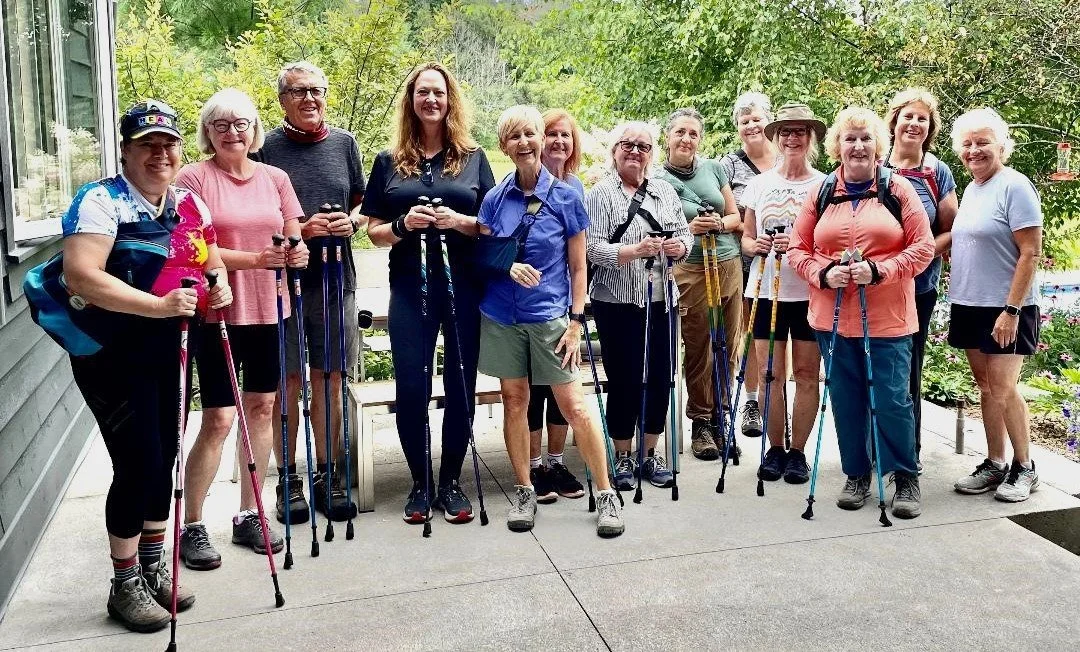
A Day in The Country Fitness Retreat - Fun & Fabulous!

What a day it was at the Day in the Country Fitness Retreat!
A wonderful group of upbeat women and men from Oakville to Collingwood came together for a day filled with fun, fitness and friendship.
We kicked off with a hike along the beautiful Bruce Trail, soaking in the fresh country air and breathtaking views. The natural beauty around us made every step a wonder.
Later, we cooled off with an energizing Olympics-themed aquafitness class with fabulous Katarina.
We enjoyed a delicious catered lunch and some snacks along the way, and of course there was time to relax, chat, and make new friends.
We were also treated to a talk by guest speaker/archivist Laura from the Museum of Dufferin who shared her vast knowledge of Dufferin County.
Under the beautiful sky, we stretched and strengthened with yoga on the grass. The sound of the birds and rustle of the leaves was the perfect backdrop as we let go of stress and connected with nature.
We wrapped up the day with a second hike, this time into gorgeous Mono Cliffs Provincial Park.
Our gracious hosts, Carol and Maarten, welcomed us into their stunning country home and estate making us feel right at home. Their warmth and hospitality added a special touch to the day.
Overall, people told me that the retreat was an absolute blast.
Should we do it again next year? Stay tuned!
"An event that I'll remember forever."
Ann, Collingwood"A perfect day of fun activites, exercise & great conversations in the most beautiful surroundings!"
Veronica, Toronto“A beautiful combination of invigoration & relaxation. Thank-you Barb for being an awesome host and lead!”
Alice, Thornbury“Fun outdoor activities in a gorgeous setting that was refreshing for the soul.”
Maurene, TorontoSome of the best scenery I’ve ever seen.”
John, Toronto"Beyond my expectations. All in all, a perfect day. I can’t wait for next year!"
Alessandra, Toronto
Can I use hiking poles for Nordic walking? Here’s Why It’s Not Recommended
To experience the full benefits of Nordic walking, it’s essential to use poles designed for Nordic walking.
Nordic walking poles are different from hiking poles in the same way that…
downhill ski poles are different than cross-country ski poles
tennis racquets are different than badminton racquets
hockey skates are different than figure skates
Different poles are required because the purposes of Nordic walking & hiking are different
Nordic walkers use Nordic walking poles to create a challenging full-body workout on hard surfaces (e.g., pavement, sidewalks, asphalt) and soft surfaces (e.g., dirt trails, sand).
Hikers use hiking poles to provide balance and stability, which helps prevent stumbles and falls, while walking on soft surfaces (e.g., dirt trails, sand).
The Handles/Straps & Tips are different

Urban Poling Nordic walking poles with strapless handles and carbide tips under the rubber boot tips
Nordic walking poles: Have thick ergonomic handles with wide ledges (Note: tradional versus contemporary styles have thin handles with a glove/strap system). They come with carbide tips (for walking on soft surfaces) covered with removable rubber boot tips (for walking on hard surfaces)
Hiking poles: They typically feature thin handles with adjustable wrist straps. They have sharp carbide tips designed for rocky and uneven surfaces.

Hiking pole handle & strap
How Nordic walking & hiking technique differ
Nordic walking poles are planted at a 45 degree angle behind your feet. With the boot-shaped tip firmly planted, pushing down and back on the handles’ wide ledges (or strap/glove system) propels your body forward, lengthens your stride, speeds up your pace, and engages almost all the muscles of the body.
Hiking poles are typically planted vertically in front of your feet. Pushing down on the wrist straps increases your stability and support.

What is Nordic Walking? A Beginner's Guide
Nordic walking is a fantastic activity that combine elements of hiking and regular walking with specially-designed poles.
Definition
Nordic walking involves walking with poles that resemble ski poles and hiking poles but are specifically designed for Nordic walking. It originated in Finland as a way for cross-country skiers to stay fit during the off-season.
Technique
With each stride, you swing a long straight arm forward, plant your pole on an angle behind you, and push down and back on the ledge or strap of the handle. This action propels the body forward. This continuous plant-push-propel action engages your core, arms, and shoulders, providing a full-body workout.
Benefits
Nordic walking offers a wide range of health benefits, including:
improved cardiovascular fitness,
enhanced upper body strength
better posture
reduced stress on hips, knees and back
increased calorie burn compared to regular walking
Versatility
Nordic walking is incredibly versatile. You can do it almost anywhere – from city parks to hiking trails to urban streets. Plus, it's suitable for people of almost all ages and fitness levels.
Differences from Hiking (also known as trekking and tramping):
Hiking involves walking in natural environments like forests or mountains. Nordic walking can be practised on a greater variety of surfaces, including pavement, sidewalks and dirt trails.
Hikers typically keep their elbows bent and use their poles in any fashion that helps them to maintain stability and balance. Nordic walkers, walk with long straight arms, swinging up to a handshake position to propel themselves forward.
Differences from Regular Walking
Regular walking engages the lower body muscles while the upper body remains relatively relaxed. Nordic walking engages both the upper and lower body, resulting in a more intense workout.
Getting Started
To get moving you just need a pair of Nordic walking poles and comfortable walking shoes.
Many parks and recreation centres and independent certified instructors offer Nordic walking classes. At a class or series of classes you’ll learn how to adjust your poles for your height, proper Nordic walking technique, and how to get the most from your workout.
Without at least one lesson, the average person defaults to a hiking technique, which offers just assistance with balance and stability and none of the additional benefits of Nordic walking.

Activator Walking Poles: Watch them in action and see the benefits
Watch how Urban Poling Activator poles magically give this walker confidence and stability. The Activators are proving to be an important fall prevention tool for people with poor balance related to illness, extended bed rest due to surgery, and ageing.
This quick before/after video shows how dramatically Activator poles can improve gait quality and walking confidence.
WITHOUT Activator poles: Slow gait speed, variable gait (steps not all the same), small tentative steps, flat foot landing, arms static.
WITH Activator poles: faster gait speed, less gait variability, longer steps, more-confident steps, noticeable heel strikes, arms active. Hurrah!
Benefits of Activator poles
Improved balance and stability
Walking with Activator poles provides a consistent two points of contact (one foot and one pole) with the floor. The poles’ unique ergonomic handles make it easy and comfortable to add them to standard walking.Improved posture
The forward and backward action of the arms activates the muscles between the shoulder blades, helping to pull the shoulders back into proper alignment. Pressing down on the ledges of the handles encourages a more-upright posture.Reduced joint impact
Offloading weight into the poles helps absorb some of the force created as the heels land with each step. This makes them helpful for individuals with joint pain and arthritis.Full-Body Workout
Activator walking poles engage muscles in the arms, shoulders, legs and core muscles creating a workout for both the upper and lower body.
Did you know?
Activator poles and Nordic walking poles are not the same
Activators are classified as walking poles or an ambulatory device. They have large rubber bell-shaped tips and a very secure button lock system (that keeps the telescoping poles locked at the correct height).Alternatively, Nordic walking poles have boot-shaped tips, and the locking system is a flip lock or twist lock.
Activator walking technique and Nordic walking technique are very different
Activator users keep their elbows at a constant 90 degree angle, swing their arms forward and back in a “choo choo train” fashion and keep their poles vertical and in front of their bodies.
Alternatively, Nordic walkers keep their poles angled back at a constant 45 degree angle. Their arms are straight and swing from the shoulders like long pendulums. They also tend to walk more vigorously than Activator walkers.Get some training
It’s ideal to have at least one lesson from a fitness professional or physiotherapist who has Activator training. Check this link to find someone in your area.“Activator” is a brand name of Vancouver walking pole company Urban Poling Inc.

What Are the Health Benefits of Nordic Walking?
Nordic walking is a versatile and accessible activity that offers multiple health benefits for people of all ages and for beginner through advanced exercisers. Here are the 6 key advantages to walking with Nordic walking poles compared to regular walking.
Nordic walking is a versatile & accessible activity that offers multiple health benefits for people of all ages & fitness levels. Here are 6 key advantages to adding Nordic walking poles to your next walk.
Increased cardiovascular fitness
Nordic walking engages both the lower and upper body, providing a full-body workout that can improve heart health and circulation.
Enhanced muscular strength and endurance
Proper Nordic walking technique engages the arms, shoulders, core, and legs leading to improved strength and endurance.
Improved posture
Nordic walking improves posture by engaging the muscles between the shoulder blades, which are key in pulling the shoulders back and into proper alignment.
Decreased impact on joints
Nordic walking poles help distribute the impact forces of walking—moving some of the forces away from the legs and into the poles —reducing stress on the knees, hips and back.
Increased calorie burn
Because the upper body is involved in the activity, Nordic walking can burn considerably more calories than regular walking.
Improved mental health
Being active in the out-of-doors—on your own, with a friend, or in a group, and especially in nature and with an elevated heartrate—helps to reduce stress and improve mood.

Test Drive #3: Yuka--My Favourite 2023 App
Scan the barcode of almost any food or cosmetic product for an instant rating of its quality from 0 to 100..

I spent a magical New Year’s Eve in Muskoka this year. Along with the usual holiday festivities, we played lots of games: Mexican Train, Wordle, Spelling Bee, Connections, and more.
Another game, new to me, emerged from a mobile app called Yuka. It unexpectedly became a big part of our fun and games.
Yuka is a free app that lets you better understand the nutritional value of a multitude of foods and cosmetics by simply scanning their barcodes.
What makes it unique is that a quick scan instantly ranks an item from zero to 100.
If this doesn’t sound interesting, trust me, it is!
“This bread gets an amazing Yuka score,” said my sister, as we were making lunch. The bread, a delicious but bland-looking white loaf from big-box store Walmart, not a health food or specialty store, scored a perfect 100. (Yuka then told us why it was so highly rated.)
Why it’s fun
The app doesn’t present any new nutritional information. Instead, it distills the info-heavy nutrional label down to one number out of a possible 100.
75-100 = excellent; 50-74 = good; 25-49 = mediocre; <25 = poor
It’s this score that makes it fun, and the scores can sometimes be surprising.
For example:
Secret antiperspirant/deodorant: 6, but Speed Stick deodorant: 79
Dempster Oats and Honey bread: 49, but Dempster 12-Grain bread: 69
PC Blue Label Memories of Szechwan sauce: 72
Canapé melba toast: 27
PC peanuts-only peanut butter: 100
I’m not a tonic drinker, but I was surprised that it rated zero! Yuka reports that it contains “additives to avoid” and is “too caloric.”
I’ve discovered that chemical additives/food colouring are frequently the culprit responsible for an unexpected low ranking (including the melba toast and bread noted above).
Fruits and vegetables aren’t rated since they would all rate 100. Alcohol and items from small indepenent brands and some bigger private labels (e.g., Costco’s Kirkland brand) are also not rated.
Bonus Info
An extra I really appreciate: the Better Choices (three or four healthier name brand alternatives) the app offers for items that have lower scores.
The Yuka app was created in France in 2011 and introduced to Canada in 2020. It prides itself on being completely independent and objective regarding its ratings, analysis, and product recommendations.
Kudos to the creators!
What is Nordic Walking & How Does it Differ From Regular Walking & Hiking?
This is the #1 most-asked question about Nordic walking on the Internet!
This is the Internet’s #1 most-asked question about Nordic walking!
Here is a quick comparison of Nordic walking, regular walking and hiking.
Nordic Walking (sometimes also called urban poling or pole walking):

Nordic walking with Nordic walking poles
Regular Walking
• Primary purpose: to improve or maintain overall physical and mental health
• Requires no special equipment
• Engages primarily the legs and glute muscles while the upper body is relatively relaxed
• Provides low to moderate cardiovascular benefits compared to Nordic walking
• Burns fewer calories compared to Nordic walking
Nordic Walking
• Primary purpose: to enjoy a fitness activity that engages the upper body muscles—including arms, shoulders, and core—and that provides a full-body workout
• Requires the use of specially-designed Nordic walking poles
• Incorporates a longer stride than regular walking, a rhythmic long-lever arm-swing motion, and a “plant, push, propel” poling technique; tips of the poles are planted behind the feet
• Provides increased cardiovascular benefits compared to regular walking
• Burns more calories compared to regular walking
• Improves posture
• Nordic walkers typically walk on relatively smooth terrain, trails and paths.
Hiking (sometimes also called trekking or tramping):
• Primary purpose: to enjoy the out-of-doors with increased stability and support, particularly on uneven terrain, and with less impact on the hips, back and knees
• Involves the use of specially-designed hiking poles
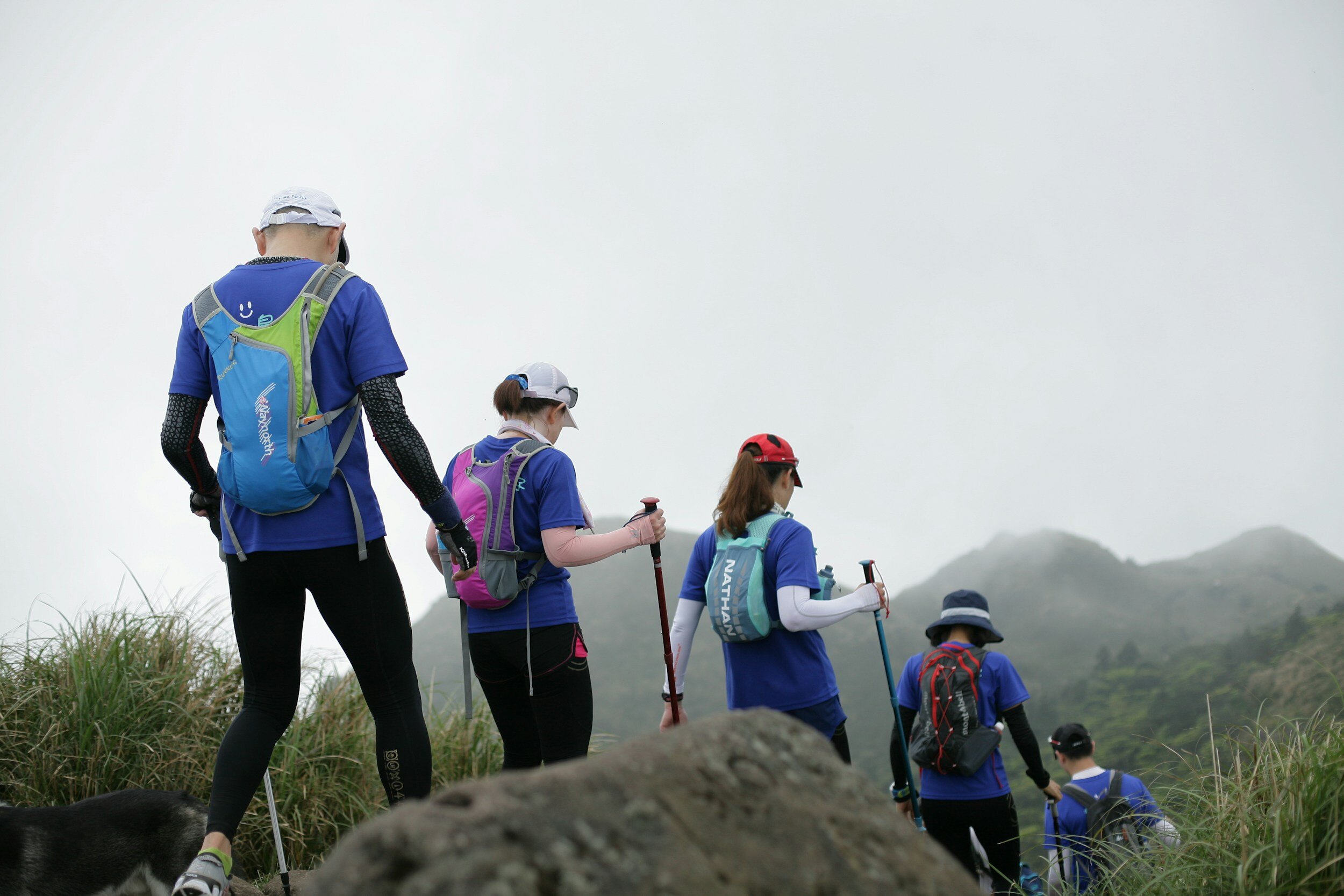
Hiking with hiking poles
• Incorporates a similar or shorter stride length than regular walking, a rhythmic bent-elbow arm swing motion; tips of the poles are generally planted in front of the body
• Engages primarily the lower body muscles, such as legs and glutes; engages the upper body when ascending and descending hills and on demanding terrain
• Hikers typically walk on surfaces that are relatively rugged, rocky, and uneven
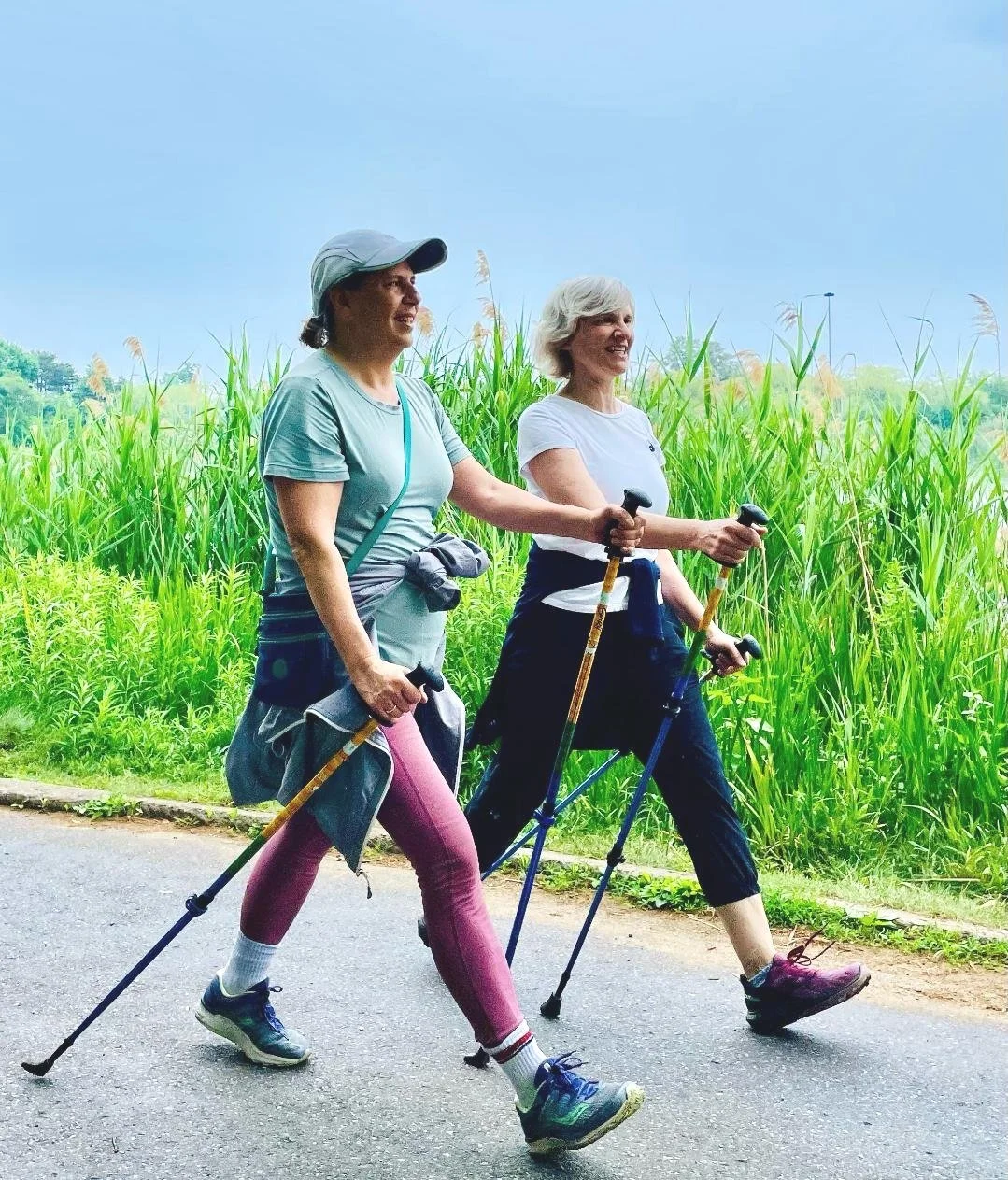
Quiz time!:

Are the people in this image Nordic walking or hiking?

Is this person Nordic walking or hiking?