
CBC Radio’s Matt Galloway speaks with Dr. Sofiya Milman about supermovers, walking speed, cognitive decline and the benefits of staying active as we age.
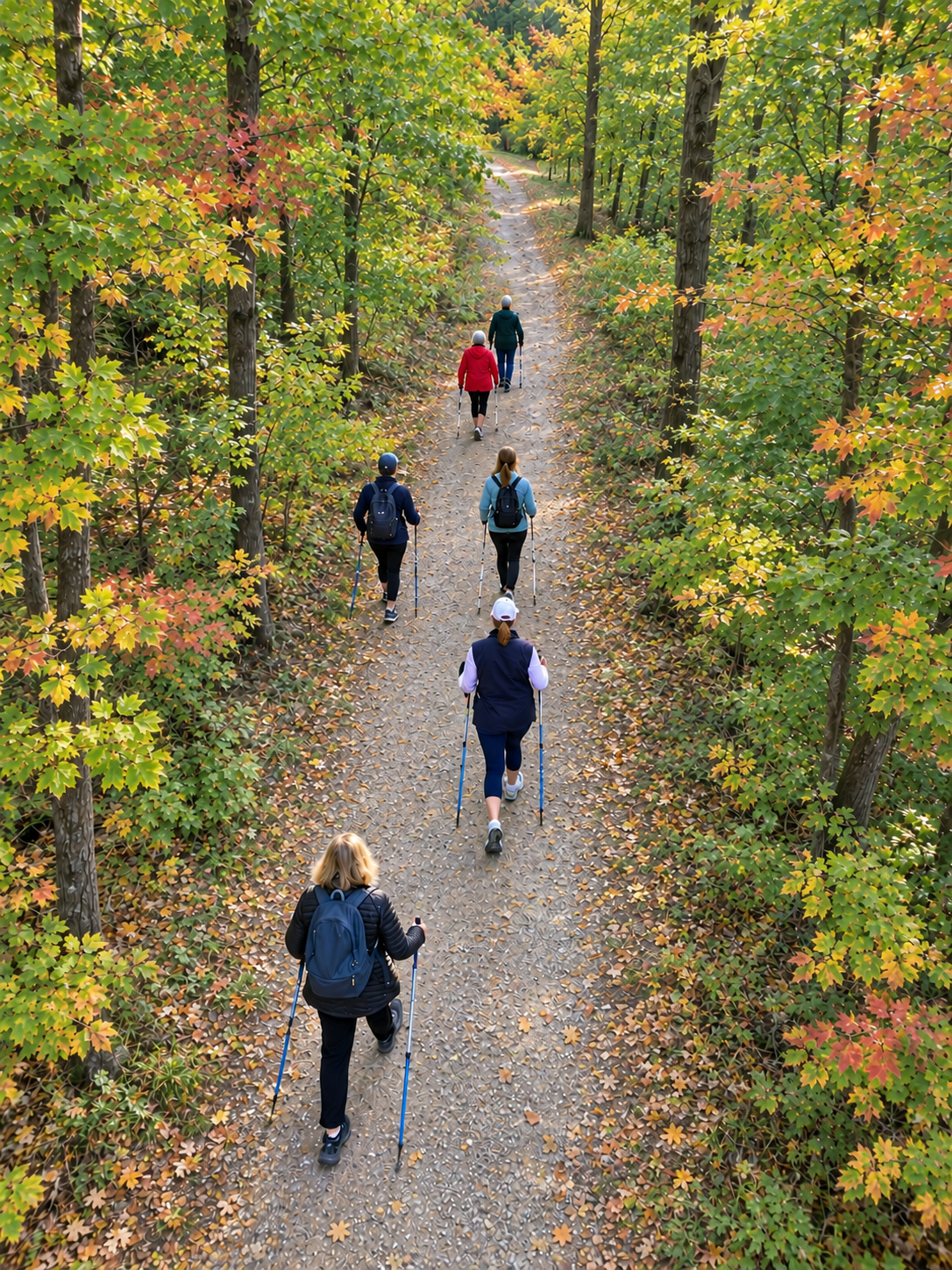
Nordic walking in the Rosedale Ravine, Toronto.
Matt Galloway: The Vancouver Venturers is a walking club. Most people here today are in their 70s. Don't be fooled by their age, though. They walk fast, and they know it.
FEMALE SPEAKER: You know, I do membership for the club, and I make a point of walking with newcomers when they come. And the most common comment I get is, “Boy, you guys walk fast!”
SPEAKER: Deters a few people, though.
FEMALE SPEAKER: Yes, sometimes.
SPEAKER: So people would come and say, well, it's too fast a pace for me. I'd rather walk slower and look at the flowers or take pictures.
FEMALE SPEAKER: But we're out for the exercise. To be able to do 10K in two hours at my age is really something and something I'm proud of and something that I want to keep on doing.
SPEAKER: I had surgery for cancer just over four weeks ago, and I'm back out walking 10 K's again, so I'm happy.
FEMALE SPEAKER: Well, I do it for the social part, the exercise part, and we go for lunch after too.
SPEAKER: Well, I think it really helps the walking and the socialization and just the different subjects you cover with people. I think the cognitive skills improve as you get older, and I can't say enough about it.
What Is a Supermover?
MG: Researchers call these folks, like the people who are out walking in East Vancouver, “supermovers.” New research has found the faster you walk as you get older, the less likely you are to develop cognitive decline. Dr. Sofiya Milman is a professor in the Department of Medicine and Genetics at the Albert Einstein College of Medicine in New York. She's one of the authors of the study. She is in New York City this morning. Dr. Milman, good morning.
SOFIYA MILMAN: Good morning.
MG: What do you make of the supermovers we just heard from in British Columbia?
SOFIYA MILMAN: I love it. They're really exemplifying what the study has found.
MG: What exactly is a supermover?
SOFIYA MILMAN: A supermover is defined as someone who is age 80 or older and their walking speed is at about the top 15 per cent or 10 per cent for their age group.
MG: How fast is that? I mean, we heard those walkers saying that they're not slowing down to look at the flowers or taking pictures. How fast, is fast?
SOFIYA MILMAN: So in the study, we found that supermovers walk at about 1.3 metres per second. And if my calculations are correct, these individuals are walking as fast as supermovers.
Walking Speed and Cognitive Health
MG: And so understanding the definition of what a supermover is, what did you want to understand in this study? And how did you go about looking at the benefits, the cognitive benefits of walking quickly?
SOFIYA MILMAN: Our goal was to understand whether supermovers are protected from cognitive decline. And in order to figure that out, we studied different groups of individuals and identified those who are supermover and then subsequently evaluated their cognition, their brain size and their propensity to develop Alzheimer's disease pathology in their brains. And what we have found was that supermovers were about 50 per cent less likely to develop cognitive decline. And their portions of the brains that are responsible for memory, the hippocampus, were larger.
MG: 50 per cent. That's a huge number.
SOFIYA MILMAN: Yes, it is indeed. We were quite surprised by that finding as well.
MG: Tell me more about that. What actually is going on in the minds of the supermovers?
SOFIYA MILMAN: We believe that walking may be a reflection of overall good health and delayed ageing in general. And so if someone is able to move faster, it's also possible that their brain is healthier and they're overall healthier. So that was one hypothesis that we have. Another hypothesis that walking itself is actually protective, as suggested by the segment that we just heard. And that may be true because we do know when people exercise, muscles actually release chemicals that seem to be neuroprotective. One such chemical is called BDNF, or brain-derived neurotrophic factor. And that can actually help the neurons in the brain function better and preserve cognitive function.
MG: One of the things, and just tell me if I'm getting this right, but one of the things I was reading about this study was that you found that in some of these supermovers, there are still the signs of Alzheimer's and dementia in their brains, but there aren't symptoms. Is that right?
SOFIYA MILMAN: Yeah, in one of the subgroups, the investigators looked at actual abnormal proteins that can accumulate in the brain of patients who develop Alzheimer's, and they found that indeed some of these supermovers did have these abnormal accumulations in their brains that are indicative of Alzheimer's disease, and yet their cognition was intact. They weren't clinically exhibiting any symptoms of Alzheimer's. And so this suggested to us, that they're resilient despite developing these abnormalities in their brains, they're still able to maintain their function and so they're able to resist this negative impact of Alzheimer's pathology.
Is Walking Itself Responsible?
MG: How do we know that this is about walking? And I guess what else might be going on that would lead those who are very active to not be manifesting the symptoms of Alzheimer's or dementia?
SOFIYA MILMAN: You know, this was an observational study, and so we cannot a hundred per cent conclude that walking itself protected them. We'll need to do additional research to determine whether it is walking itself. A lot of research has shown so far, though, that being physically active and exercising is protective for our brains. So we definitely have some evidence to support that. And we do need to more research.
MG: This also picks up on research that was done and observations that were done years ago, right? And it's, I guess, going in the opposite direction, that people who had a slower gait in some ways were linked to poorer health. What do we know about that and how this kind of builds on that research?
SOFIYA MILMAN: Again, we really have to think about the body as a whole. And our gait may reflect overall ageing processes, and our brain is certainly not separate from our physical health. All of our body systems are interrelated. Therefore, if someone has slower gait, it may be a marker of general health decline. And on the flip side, if somebody works faster, this may be marker of overall better general health.
The Benefits of Walking Together
MG: One of the things we heard in those clips from the folks in East Vancouver and the Vancouver Venturers is that they enjoy walking together. And maybe that means that you have to arrive on time to be part of the group, but they like to be a part of a group. How important is the social aspect of activity for brain health?
SOFIYA MILMAN: Yeah, that's a really important question. We do know that social activity in and of itself is protective for the brain. And we know that exercise is protective for the brain. Now the question is, if you do exercise in a group and if you combine both social interactions and physical activity, are you going to derive additional benefits? We suspect that the answer is yes, that walking by itself is protective, social activities protective, and when you combine them together, it may actually be even better, so these people may really be onto something.
It's Never Too Late to Start
MG: It's so interesting because, again, we know that, whether you're doing the Wordle or Sudoku or something like that, that we have been told for a long time now that exercising your brain is a good way to stave off some of the side effects of getting older. But this is just about exercise generally. So how can somebody pick this up? At what point in time can somebody become a supermover?
SOFIYA MILMAN: So the study doesn't answer this question. However, we have evidence from other studies that suggest it's never too late. In fact, there were studies that showed that older adults who began to exercise have actually derived quite a bit of benefit and maybe even more so than their younger counterparts, especially if they were able to be consistent with it, maybe easier for older adults to be consistent with exercise. Most of them may be retired and they may have more time. And so the takeaway is really that it's never too late to start.
MG: If somebody wants to start, do you have, again, you're not a physiotherapist or an exercise guru, but you're somebody who has studied this, what advice would you give to somebody who wants to become a supermover? They hear the evidence here, and they think I should take advantage of that.
SOFIYA MILMAN: So I would say that if you're not walking yet, start walking at whatever pace is comfortable for you. If you are already walking, see if you can walk more frequently for longer or at a faster pace. And if you can walk faster, do it, but make sure you're doing it in a safe way.
Keeping Up the Pace as We Age
MG: I'm always interested in whether the people who do this research take it to heart themselves. Are you now walking faster as you get older because of what you have learned in this research?
SOFIYA MILMAN: I think I've always been a fast walker because I feel like I'm always rushing, but this gives me even more reason to continue doing that.
MG: And to keep it up as you get older.
SOFIYA MILMAN: Yes, that's right.
MG: This is so interesting. We will see whether we see, end up anecdotally seeing people in groups walking faster because of what you have learned in the meantime. Dr. Milman, thank you very much.
SOFIYA MILMAN: My pleasure. Thank you.
MG: Dr. Sofiya Milman is a professor in the Department of Medicine and Genetics at the Albert Einstein College of Medicine in New York. Those are your marching orders. March quickly, she says. That is The Current for this Monday, the 14th of September.
