If you're a Nordic walker, you know the challenge of maintaining consistently long arm swings. It sounds easy: swing your hands up into a long handshake position and then back down low, alongside your thighs. But it can take some people a surprising amount of time to master.
Why? It's just too easy and more comfortable to slip into a hiking-style arm action, with bent elbows and arms swinging like short levers at waist height.
Why is it important? Maintaining long arm swings is essential if you want to get the cardiovascular, muscular and postural benefits that Nordic walking offers.
How instructors encourage a long arm swing
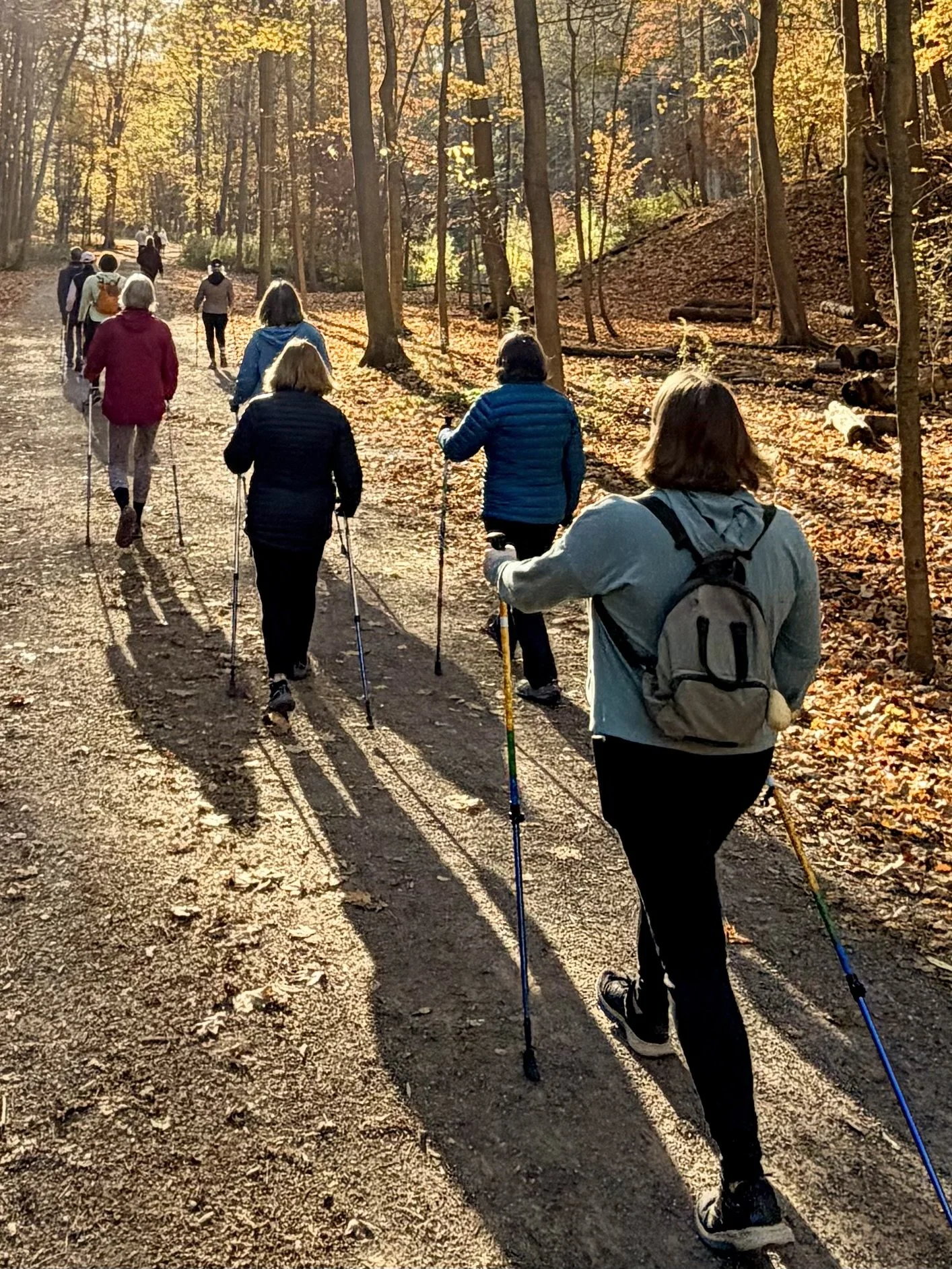
My Saturday morning Nordic walking class on a crisp fall morning in the Vale of Avoca in the Rosedale ravine, Toronto.
Over my years as a Nordic walking instructor, I've learned that there's no one magic cue. Everyone learns differently, so I use a variety of verbal cues and demonstrations in my classes and clinics.
I often use these verbal cues:
The pendulum image: “Swing your arms from the shoulders, like two very long pendulums.”
The military image: “Imagine you’re proudly marching on parade…eyes up, chest proud, and arms long.”
The handshake cue: “Swing your hands up as if you were shaking hands with someone your height.”
Watch and mimic: “Let's walk together in the same rhythm. Can you swing your arms the way I am?”
What's wrong with this picture?
Sometimes, I turn the tables and ask participants to watch me Nordic walking and tell me what I'm doing wrong. “What do you see? What could you say to help me correct this?” It's a fun way to get people recognizing the differences between not-so-good and good technique.
Learn by observing others
When another Nordic walker outside our group happens to pass by with poor technique, I might quietly say, “Let's discreetly watch this person and discuss their technique once they've passed.” It's another opportunity for participants to feel good about being able to identify what isn't quite right and knowing how to correct it.
Other teaching techniques:
Use photographs: In my Quick-Start Clinics, I hold up photographs of people demonstrating excellent Nordic walking technique. A picture can help make the desired arm position and movement much easier to understand.
A little hands-on guidance: I sometimes come alongside participants and gently push a bent elbow towards a straighter position as the arm swings forward. Sometimes a little physical guidance helps people find a position they couldn't quite achieve on their own.
Remember, the benefits of Nordic walking are closely tied to how effectively you use your poles. The better your technique, the more you can get out of each walk and the more benefits you're likely to enjoy.
Interested in learning how to Nordic walk? Check out my Quick-Start clinics here. I supply the poles, instruction, and a fun, relaxed, learning environment!
